
ACP vs UCP: A Practical Guide to the Two Agentic Commerce Protocols
Compare Agentic Commerce Protocol (ACP) and Universal Commerce Protocol (UCP) across scope, discovery, checkout, payments, capability negotiation, and merchant adoption.
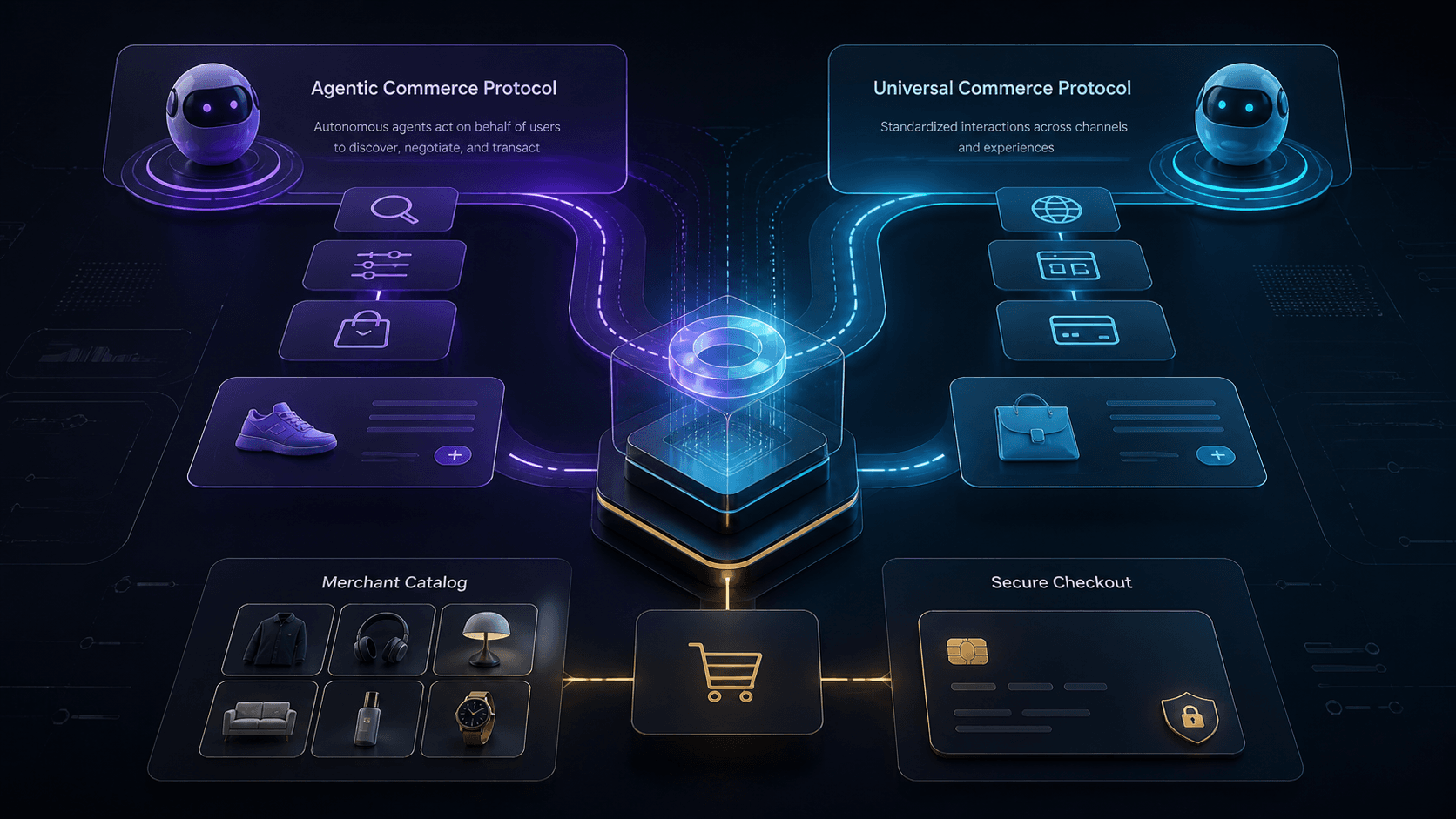
ACP and UCP address the same strategic shift: software agents need deterministic interfaces for commerce instead of brittle browser automation. They are not interchangeable names for one standard, however. ACP is closely centered on agent-mediated purchase flows, while UCP defines a broader, capability-oriented interoperability model spanning discovery, checkout, identity, orders, and payment participants.
What is ACP?
Agentic Commerce Protocol (ACP) is an open specification for programmatic exchange between buyers, their AI agents, and sellers to complete a purchase. In the reference architecture, the agent presents the checkout interface and collects buyer selections and payment credentials, while the seller retains its backend data model and payment processing responsibilities.
ACP replaces browser clicking with declared interfaces for checkout and secure credential relay. Implementations can expose a RESTful interface or an MCP server. This gives an agent a more deterministic way to create and update checkout state, surface requirements to the buyer, and submit an order.
What is UCP?
Universal Commerce Protocol (UCP) is an open interoperability standard for platforms, businesses, credential providers, and payment service providers. A business publishes a public profile at /.well-known/ucp declaring the versions, services, endpoints, transports, capabilities, and extensions it supports.
UCP’s capability model is deliberately broad. Current specification examples include catalog search and lookup, cart management, checkout, fulfillment, identity linking, and order lifecycle events. A platform and business negotiate the exact intersection they both support, which helps implementations evolve without pretending every participant offers the same workflow.
ACP vs UCP at a glance
The most useful comparison is architectural rather than promotional. Both aim to make commerce agent-compatible, keep the merchant involved in transaction processing, and support secure payment credential handling. Their abstractions and discovery patterns are different.
| Dimension | ACP | UCP |
|---|---|---|
| Primary emphasis | Agent-mediated purchase and checkout exchange | Interoperability across discovery, checkout, identity, orders, and payments |
| Participants | Buyer, agent/application, seller, payment provider | Platform, business, credential provider, payment service provider |
| Discovery | Implementation and application integration details | Public business profile at /.well-known/ucp |
| Capability model | Checkout lifecycle, payment and extensions | Versioned services, capabilities, extensions, and exact negotiation |
| Transports | REST or MCP | REST, MCP, A2A, and declared bindings |
| Best first question | Can this agent complete a supported seller checkout? | What capabilities does this business expose to compatible platforms? |
Do merchants need to choose one?
Not necessarily. Protocol adoption is driven by the commerce surfaces a merchant wants to reach, the capabilities those surfaces require, and what the merchant’s platform can implement safely. Supporting one protocol does not automatically make the other unnecessary, and publishing a discovery feed is not the same as supporting end-to-end checkout.
Start with normalized internal product and order models. Put protocol-specific serialization behind adapters. That makes it easier to support multiple standards without allowing their changing schemas to leak through the entire commerce application.
A safe implementation sequence
Begin with read-only discovery: accurate product identity, price, availability, variants, canonical URLs, and a clearly versioned endpoint. Next, add public capability discovery and conformance tests. Only then consider state-changing cart, checkout, identity, payment, and order operations.
Transactional support needs substantially more control than a public checker can validate. Authentication, authorization, idempotency, inventory races, tax, fulfillment, refunds, webhook verification, payment-token boundaries, and customer consent all need production-grade treatment.
- Keep the merchant’s catalog model independent from ACP and UCP payloads.
- Fail closed when a licensed or authenticated capability is unavailable.
- Use idempotency keys for every state-changing commerce operation.
- Never advertise checkout, identity, or order capabilities that are only planned.
- Re-verify the current specifications before changing protocol schemas.
How to assess ACP and UCP readiness
A public ACP check can confirm that an advertised feed is reachable, structurally valid, versioned, and populated. It cannot prove that an authenticated checkout works. A UCP check can retrieve /.well-known/ucp and validate the declared versions, services, endpoints, and capabilities. It still cannot certify transaction execution without a controlled test environment.
The distinction between discovery, advertised capability, and verified execution should appear in dashboards and reports. It protects merchants from false confidence and gives engineers a much clearer implementation backlog.
WooCommerce implementation
Build an evidence-based agentic commerce layer with Clustova Commerce
Clustova Commerce Free publishes a normalized public ACP catalog feed and deterministic GEO readiness signals. Clustova Commerce Pro adds a license-gated UCP business profile and currently advertises only its implemented read-only catalog-search capability—without claiming transactional checkout support.
Frequently asked questions
What is the main difference between ACP and UCP?
ACP is centered on programmatic agent-to-seller purchase and checkout flows. UCP is a broader capability-oriented interoperability standard covering discovery, checkout, identity, orders, and payment participants.
Can a store support both ACP and UCP?
Yes. A merchant can expose multiple protocol adapters over one normalized catalog and commerce system, provided each advertised capability is implemented, secured, versioned, and tested independently.
Does a valid ACP feed or UCP profile prove checkout works?
No. Public validation proves discovery or structural readiness only. Transactional verification requires controlled authenticated testing of the actual cart, payment, order, and recovery flows.
Primary specifications and further reading
Muhammad Afzal is the founder of Clustova. He builds AI-powered tools that help content marketers, agencies and developers produce high-quality, search-ready content at scale. He writes about SEO, AI content pipelines and the future of content marketing.